Choose a competitor monitor tool by the evidence you need: a changed webpage, a comparable product price, a search position, a social mention or an advertising creative. These are different data sources. A tool that detects a new sentence on a pricing page does not thereby measure the competitor's search visibility, sales or advertising performance.
Start with the question your team needs to answer, then select a category. This guide helps you separate those categories and recognise when a small page-monitoring service is enough. It is not a ranking of vendors, a promise of complete market coverage or another price-software buying checklist.
Turn “monitor our competitors” into a testable request
A competitor monitoring tool collects or checks information about other businesses repeatedly. Its usefulness depends on what it observes, how it identifies a change and what your team can do with the result. “Monitor everything” is not a useful acceptance criterion.
Write one sentence: When this source changes in this way, this person needs this evidence to consider this action. For example, “When a known supplier changes its public delivery conditions, our account team needs the source page so it can verify the change.” That request suggests page monitoring. “When a rival overtakes us for a search query in a particular country” requires search-position data instead.
Three questions that choose the category
- Where does the evidence live? On known pages, inside search results, across social conversations, in ad libraries or in a marketplace dataset?
- What is the unit you must follow? A URL, a query and location, a product and seller, a mention, or an account-level insight?
- What must the result let you do? Reopen a page, compare structured observations, find a conversation or distribute a reviewed sales brief?
If these answers point to different sources, you may need two complementary tools. Buying a larger dashboard does not automatically make incompatible observations comparable.
Match the source to the tool category
The table describes typical jobs, not guaranteed features of every vendor. Ask each provider to demonstrate its actual coverage. A SKU is a stock-keeping identifier used in a catalogue; it is not necessarily a universal product identifier shared by competing retailers.
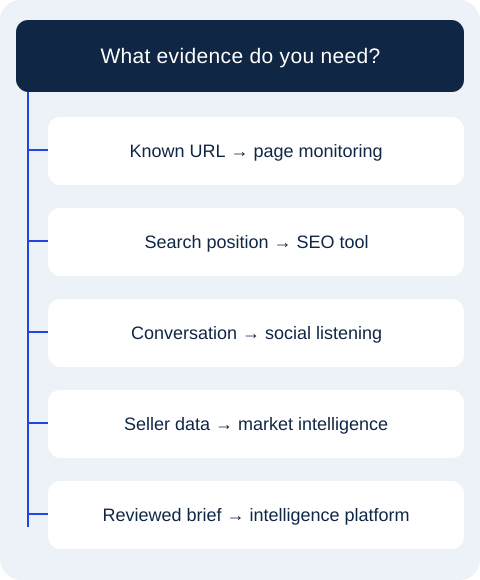
| Need | Category / data | Typical automation and useful scale | ChangeWatch fit |
|---|---|---|---|
| Know when selected pages change | Webpage change monitoring / public URLs | Scheduled checks and alerts; a known page shortlist | Potentially, subject to page compatibility |
| Compare prices across many products | Price monitoring or price intelligence / matched product offers | Repeated price collection and structured comparisons; catalogue workflows | Selected compatible pages only, not a catalogue-scale price database |
| Track search rankings | SEO monitoring / query, location, device and position | Scheduled ranking observations for a defined query set | No: not an SEO rank tracker |
| Follow discussions about brands | Social listening / mentions and conversations | Collection and filtering across supported sources | No: not a social listening platform |
| Inspect competitors' advertising | Advertising monitoring / creatives and available ad metadata | Library search or monitoring within documented platform coverage | No advertising intelligence dataset |
| Understand marketplace competition | Marketplace intelligence / listings, sellers and available market metrics | Platform-specific collection or estimates, with coverage limits | No comprehensive marketplace intelligence |
| Distribute reviewed competitive knowledge | Competitive-intelligence platform / evidence and team insights | Collection, organisation and collaboration; depends on the platform | A possible page-alert input, not a full intelligence platform |
Social listening means following and interpreting conversations about a subject or brand. Competitive intelligence means collecting and assessing information to support business decisions; it is broader than watching a website. Neither label guarantees that all sources are available or that automated interpretations are correct.
Check the boundary between an observation and an inference
A changed page is not a ranking change
A competitor can rewrite a page without gaining a search position. Conversely, positions can move while its page remains unchanged. A rank tracker such as Ahrefs Rank Tracker illustrates a different category: monitoring keywords and ranking performance. This is a category example, not a recommendation based on an independent product test.
An ad you can see is not a sales result
Finding a creative tells you something about a message being advertised, not whether it is profitable. Public ad libraries and commercial advertising tools have their own coverage and metadata. Do not treat the absence of a creative in one source as proof that a company has stopped advertising everywhere.
A mention is not a market share measurement
A social listening service, such as the category described by Meltwater, addresses conversations and mentions. A count of collected mentions depends on its source coverage and query settings. It does not directly tell you how many products a rival sold or how every customer feels.
A marketplace estimate is not a competitor's ledger
Ask whether each metric is observed, estimated or supplied by an integration. If a provider estimates sales or traffic, keep its method and limitations attached to the number. Your team's report should not silently turn an estimate into an audited business result.
These boundaries matter even when an interface calls all of its outputs “insights”. Require a route back to the evidence and a date. If the source is missing or unreadable, the result should remain uncertain.
Three fictional requests, three different choices
The following scenarios are fictional. They describe selection decisions, not ChangeWatch customers or measured outcomes.
A small supplier watching commercial terms
A sales team knows six competitor pages: two pricing pages, two delivery-policy pages and two service descriptions. It wants to notice relevant wording changes and inspect the source. Page monitoring is a plausible starting point, subject to compatibility. A traffic-estimation platform does not solve that specific task merely because it lists those competitors.
An e-commerce team matching a catalogue
A retailer wants to compare 4,000 internal SKUs with equivalent offers across multiple sellers, retain structured history and export data. That request belongs to catalogue-scale price intelligence and product matching. A list of page-change emails is not an equivalent deliverable. Use our price tracking software guide for the detailed price-specific selection criteria.
A marketing team with two separate questions
The team wants to follow competitor search rankings and notice changes to three campaign landing pages. Those are two jobs: ranking evidence for specified queries, and page-change evidence for known URLs. It can evaluate a tool in each category instead of demanding that a page monitor infer SEO performance. Assign one person to review the combined evidence; more feeds do not automatically produce a useful conclusion.
Ask for the proof that belongs to your category
Use a small acceptance exercise that you can inspect. The objective is not to award a score to every feature; it is to rule out a tool that cannot supply the evidence you need.
| Selected job | Ask to see | Do not accept as a substitute |
|---|---|---|
| Known-page monitoring | A supported URL, the relevant change, check timing and a source you can reopen | A claim to watch an entire site without explaining coverage |
| Search monitoring | The query, country/location, device context and observation date | An unexplained global “visibility” score |
| Product-price intelligence | A matched product/variant, seller, conditions and uncertain matches | Two similar product titles treated as identical |
| Social or advertising monitoring | Supported sources, a retrievable item and limits on the query or period | A promise to see every conversation or campaign |
| Team intelligence | Source attribution, a review owner and the path to update an outdated brief | An automatic summary with no evidence trail |
Then check practical constraints: the number of units billed, check frequency, alert recipients, required exports, user access and the work needed to maintain the setup. An export requirement can eliminate a tool immediately; do not postpone it until after purchase. A dynamic page builds or changes content during a visit, and a false positive is a signal interpreted as meaningful when it came from something irrelevant or incomparable. Both should be discussed in a page-monitoring demonstration.
For recurring price-check operations after choosing a tool, use competitor price monitoring. For interpreting comparable numbers, use competitor price analysis. This selection exercise deliberately stops before those workflows.
Where ChangeWatch fits the selection
ChangeWatch monitors selected compatible public webpages automatically and sends email alerts when a relevant change is detected. It may help follow visible prices, promotions, availability, displayed offers or commercial and delivery conditions, depending on the page and agreed scope.
It is a potential fit when you already know the competitors and URLs that matter and want to reduce repeated manual checks. Compatibility is established during configuration; an optional enquiry can clarify it before you subscribe. The fictional demonstration shows the page-to-email process.
ChangeWatch does not provide automatic repricing, strategic recommendations, catalogue-scale scraping, exhaustive site coverage, a complete normalised price-history database, bulk exports, unlimited monitoring or real-time detection. It does not make commercial decisions. Pagination and extraction limits may leave some information outside the monitored scope, and changes can occur between checks.
If the requirement is rankings, social conversations or a market-wide dataset, choose a category designed for that evidence. A page monitor may supplement it, but does not replace it. For the broader organisation of an e-commerce monitoring programme, see our general competitor monitoring guide.
Questions to resolve before choosing
Is there one competitor monitor tool for every need?
No single category supplies every kind of evidence. Some platforms combine functions; confirm each relevant source, output and limitation rather than assuming the suite covers your whole request.
Do I need automatic analysis?
Only if that is a real requirement and the output can be checked. A source-linked alert can be sufficient when your team knows how to interpret it. An automatically generated explanation is still something to verify.
Can a free tool be enough?
It can be, if its current coverage, limits and maintenance demands fit the job. Test the actual output. This guide makes no unverified promise about a vendor's free plan.
Comments
Have a question, feedback or experience to share?